About
EN
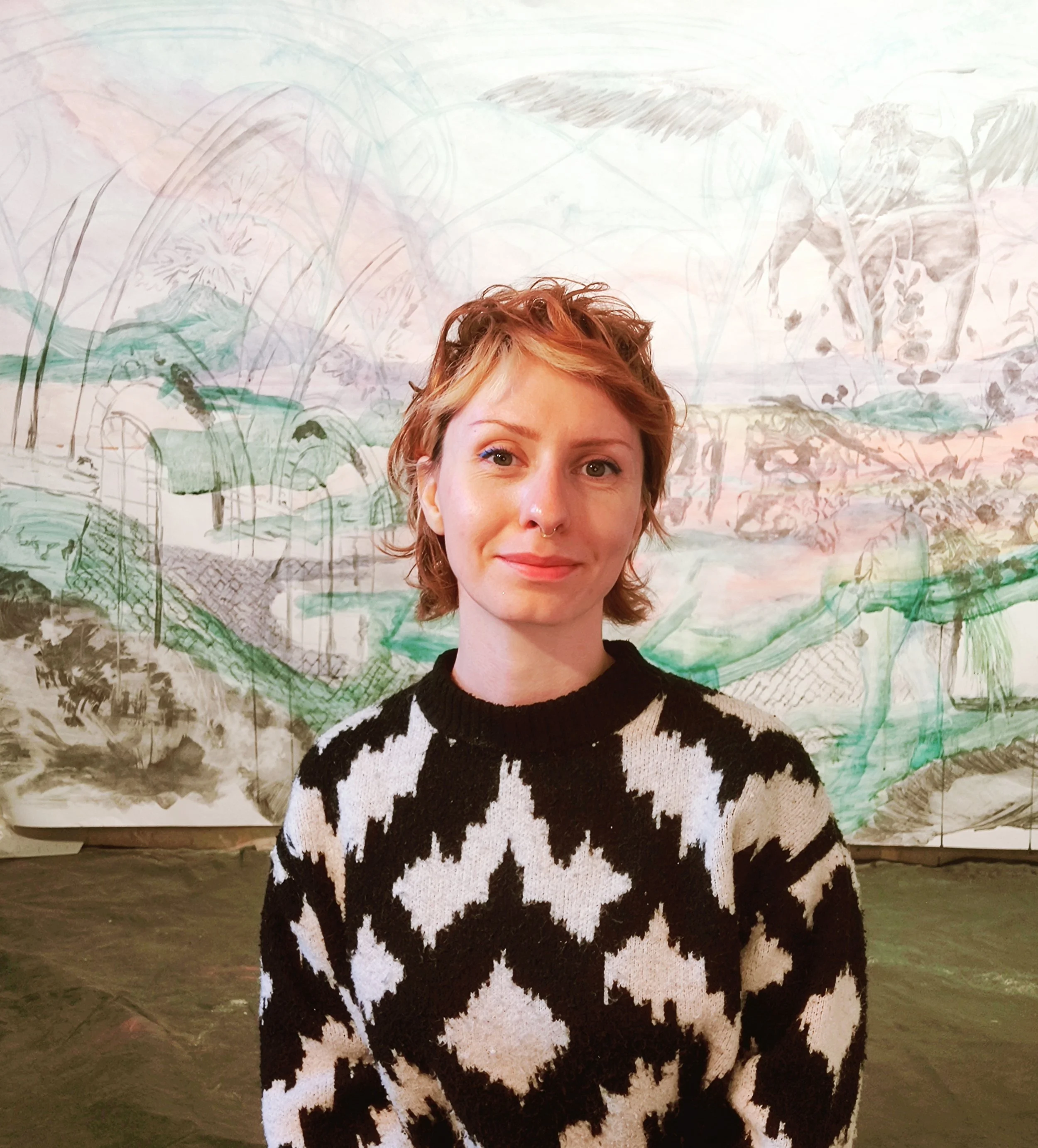
Eftihia Karanika (1995) is a Greek-American artist born in Chicago and based in Angers, France. She holds a bachelor's degree in French and anthropology from North Central College (Naperville) as well as a DNA and DNSEP from the École Supérieure des Beaux-Arts in Angers. She is also a singer, songwriter, and composer for the Greek laïko band Amartia Mou.
Her multidisciplinary research lies at the intersection of art and anthropology, allowing drawing, writing, and sound to come together to question memory, loss, and heritage. Anchored in qualitative fieldwork—interviews, surveys of territory, collections of family or institutional archives—her work also draws on the studies of other researchers. These sources constitute the raw material for palimpsestic drawings in which real or imaginary landscapes are interwoven with ethnographic or invented figures. Where research cannot fill the gaps, she turns to creative writing, song, sound installation and drawing itself to bridge memory and absence, turning the distance between them into a space for creation.
FR
Eftihia Karanika (1995) est une artiste gréco-américaine née à Chicago et basée à Angers. Titulaire d’une licence en français et en anthropologie du North Central College (Naperville), elle est aussi diplômée d’un DNA et d’un DNSEP de l’École Supérieure des Beaux-Arts d’Angers. Eftihia est également chanteuse, parolière et compositrice pour le groupe de laïko grec Amartia Mou.
Sa recherche multidisciplinaire se situe au croisement entre l’art et l’anthropologie, permettant la rencontre entre le dessin, l’écriture, et le son d'interroger la mémoire, la perte et l’héritage. Ancré dans une démarche qualitative – entretiens, arpentages de territoire, collecte d’archives familiales ou institutionnelles –, son travail puise également dans les études d’autres chercheurs. Ces matériaux constituent la matière première de dessins-palimpstes où paysages réels ou imaginaires se mêlent à des figures ethnographiques ou inventées. Lorsque la recherche ne suffit pas à combler les écarts, elle se prolonge dans l’écriture créative, la chanson, les installations sonores et le dessin lui-même, afin de faire pont entre mémoire et absence, transformant la distance qui les sépare en un espace de création.